



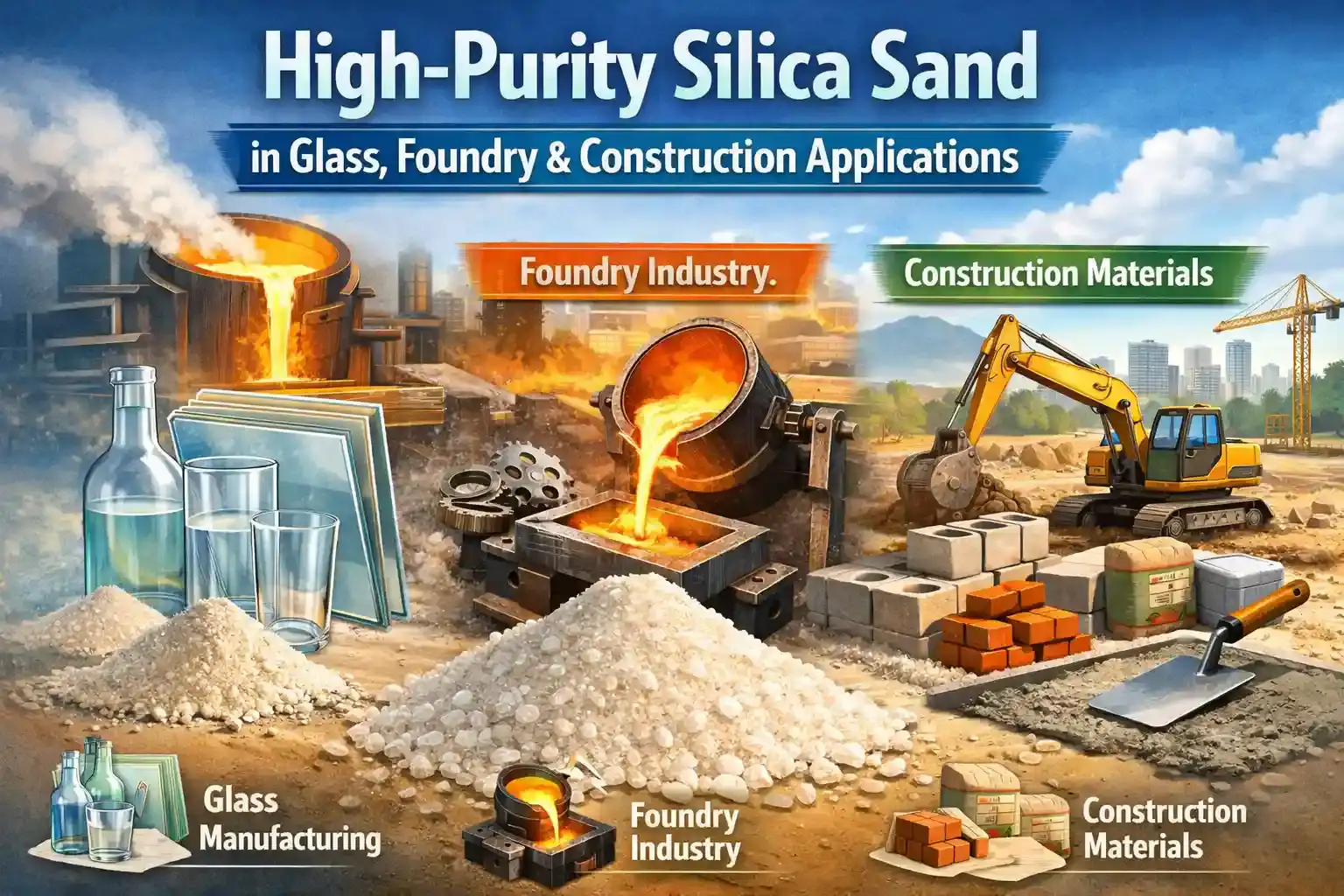
Most people see sand as dirt. You, as an industrialist, need to see it differently. High-purity silica sand is the major raw material of three major industries. It makes your smartphone screen possible. It creates the molds that shape engine blocks. It gives concrete the strength to hold up skyscrapers.
The problem is that many businesses treat silica sand as a commodity. They buy the cheapest available. They assume “sand is sand.”
That assumption costs money. It causes quality failures. It creates supply chain headaches. This blog explains exactly how high-purity silica sand works in glass manufacturing, foundry operations, and construction applications. You will learn what purity levels matter. You will understand why grain shape and size control are critical. You will know what to ask your supplier.
High-purity silica sand contains at least 99.5% silicon dioxide (SiO₂). Mineral impurities such as iron oxide, alumina, titanium dioxide, and chromium are kept to very low levels.
Purity determines where the sand can be used.
|
Purity Level |
Typical SiO₂ % |
Common Sector |
|
Standard |
95%–99% |
Construction |
|
High |
99%–99.5% |
Foundry |
|
Ultra-high |
99.5%–99.9% |
Glass (flat, container, specialty) |
|
Electronic grade |
> 99.9% |
Semiconductor quartz |
Why this matters for your business:
Purity level is directly linked with cost of the sand. So if you order sand of higher purity level than is required you will end up paying more. If you order sand of lower purity your end product fails to meet quality requirements. One wrong raw material specification can shut down a production line for days.
In glass production, silica sand provides the primary network former. It supplies the SiO₂ backbone that gives glass its structure. Without silica sand, there is no glass.
Real-world uses across glass types
Flat glass requires ultra-high purity with very low iron content. Iron causes a green tint which is an indicator of low quality. For clear windows and windshields, iron oxide must stay below 0.01%.
Container glass uses medium purity. Slight color variations are acceptable for beer bottles and jars. However, the grain size needs to be uniform for a precise melt rate.
Fiberglass needs specific chemical properties to control melt viscosity. In this case the sand must have the correct balance of SiO₂ and other oxides.
Specialty glass, which includes solar panels and LCD screens, are advanced technology products where only the highest purity is required. Even trace contaminants can result in a defective final product.
Parameters that Determine Purity
• Iron content (measured as Fe₂O₃) directly affects color.
• Grain size distribution which determines the rate of melting. Too coarse creates defects. Too fine increases energy consumption.
• Refractory minerals like chromite or zircon cause stones and cords in the final glass. These are unacceptable in high-end products.
One batch of sand with elevated iron can ruin an entire furnace cycle. You cannot recover that cost.
In the foundry sector, silica sand is the main molding material for both ferrous and non-ferrous casting operations. It holds the shape of the mold and also withstands molten metal temperatures. It determines the surface quality of the final casting.
Real-world uses
Green sand molding uses clay-bonded silica sand. It is the standard method for iron and steel castings.
Resin-coated sand creates shell molds. It gives better surface finish and dimensional accuracy.
Core making uses chemically bonded sand to form internal cavities in castings.
Why purity and grain shape matter:
Round grains flow better. They require less binder and this reduces input costs
Angular grains give higher green strength. However, they consume more resin.
The AFS grain fineness number is a metric that determines mold permeability and surface finish. Coarser sand allows gas to escape but leaves a rougher surface. Finer sand gives a smooth finish but may trap gases.
Critical parameters to watch
|
Parameter |
Ideal Range |
Why It Matters |
|
AFS number |
45–80 (varies by casting) |
Controls permeability and finish |
|
Clay content |
< 0.5% |
Reduces binder consumption |
|
Acid demand value (ADV) |
Low |
Prevents premature curing of chemical binders |
|
Sinter point |
> 1,200°C |
Prevents sand fusion to the casting surface |
Ignoring ADV can cause binder failure in the middle of a pour. You lose the mold. You lose the casting. You lose production time.
In construction, high-purity silica sand is not just filler. It provides specific performance properties that standard aggregates cannot match.
Real-world uses
Concrete and mortar use silica sand as fine aggregate. Purity affects workability and strength. High clay content increases water demand fiwhich weakens the concrete.
Tile grout requires sand with controlled particle size. Too coarse causes shrinkage cracks. Too fine causes powdering.
Flooring systems (epoxy and polyurethane) use silica sand for abrasion resistance. The sand must be dry and low in moisture.
Water filtration uses specialty silica sand. It must meet NSF 61 certification for potable water contact.
Asphalt uses sand as filler to improve stability. Purity matters less here, but grading consistency is important.
What construction buyers must know
Particle shape affects compaction. Sub-angular to rounded sands pack better than purely angular sands. Respirable crystalline silica is a regulatory concern. OSHA has strict exposure limits. You must manage dust control regardless of the application.
Construction sand is not the same as foundry sand. Even within construction, different applications demand different specifications. A common mistake is using concrete sand for tile grout. It does not work.
You need a method to match sand specifications to your application. Here is a five-step process.
First, define your end product quality requirements. Are you making window glass or sewer pipes? The answer determines everything.
Second, determine the minimum purity threshold. Test for iron, alumina, and titanium.
Third, specify particle size distribution using sieve analysis. Do not rely on generic grades.
Fourth, evaluate grain shape. Spherical sand flows better. Angular sand locks tighter. Choose based on your process.
Fifth, check impurity limits specific to your sector. For glass, watch for refractory minerals. For foundry, watch for ADV. For construction, watch for clay content.
Decision matrix for Each Industry
|
Decision Factor |
Glass |
Foundry |
Construction |
|
Purity priority |
Highest |
Medium |
Low to medium |
|
Grain shape priority |
Spherical |
Spherical to sub-angular |
Sub-angular to angular |
|
Size consistency need |
High |
High |
Medium |
|
Regulatory concern |
Refractory defects |
ADV, binder compatibility |
Respirable silica dust |
|
Typical price point |
High |
Medium |
Low |
Using this framework prevents costly mismatches. It also speeds up supplier qualification.
High-purity silica sand deposits are not evenly distributed and are available from selected locations only. Major sources include Wisconsin (USA), Texas, Belgium, Germany, Australia, and India.
Another issue that affects sourcing cost is the level of processing required for silica sand after mining. Mined sand undergoes processing of several stages that involves washing, scrubbing, flotation, and magnetic separation to reach a specific purity level. Each processing step adds cost.
Transportation is another major factor that can add to the procurement budget. Silica sand is heavy and freight costs can exceed the material cost itself.
Questions to ask potential suppliers:
• Can you provide a full mineralogical analysis for each deposit?
• What is your typical batch-to-batch variability for Fe₂O₃ and grain size?
• Do you test AFS number or sieve analysis per shipment?
• Do your products fulfil ASTM or ISO standards?
One unreliable supplier can disrupt your entire production schedule. Do not assume all suppliers are equal.
High-purity silica sand is not just a commodity. It is a process-optimized raw material that directly determines end product quality across glass, foundry, and construction industries. Treating it as generic filler is a mistake that costs you money, quality, and time.
The difference between a perfect product and a rejected one starts with the sand. The difference between a clean casting and a scrap part starts with the sand. The difference between a stable concrete mix and a failed slab starts with the sand. Know your sand. Choose deliberately. Your competition is already doing it.
Modern microchips have to comply with strict quality standards for global compliance. Every funct
READ FULLMore spec sheets state that it's high purity than actually prove it. You'll find ten different pu
READ FULLFor a single lot of 300mm silicon wafers, the accumulated processing cost can reach hundreds of t
READ FULL