




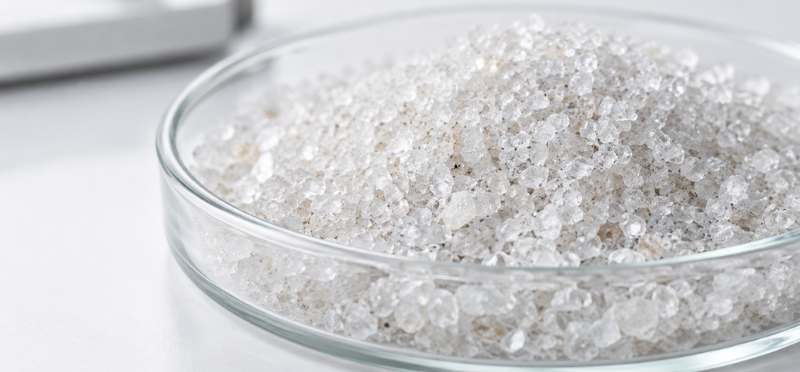
More spec sheets state that it's high purity than actually prove it. You'll find ten different purity numbers from ten different suppliers of quartz sand, with some supported by lab data and others (specifically those with "premium" in the product name) unsupported.
That is not the distance it should be. A glass manufacturer is using sand that varies in its SiO₂ composition from batch to batch and notices it in the seed count and color. To a semiconductor or solar processor, it is not the cost of the sand that matters but the cost of the loss of yield. When you're shopping around, you're not asking, "Who can I trust?" you're asking, "Who can I test to see if they're trustworthy.
This article is the technical continuation of this question. No sales pitch about vetting reputations, just the actual numbers, certifications, and documentation that should be required before signing a purchase order: purity percentages by grade, mesh size ranges by application, trace element limits, and what a legitimate Certificate of Analysis should include. If you're still winnowing down which supplier to work with, this article builds on that help by covering all the work that goes into choosing the right high-purity silica sand for your project.
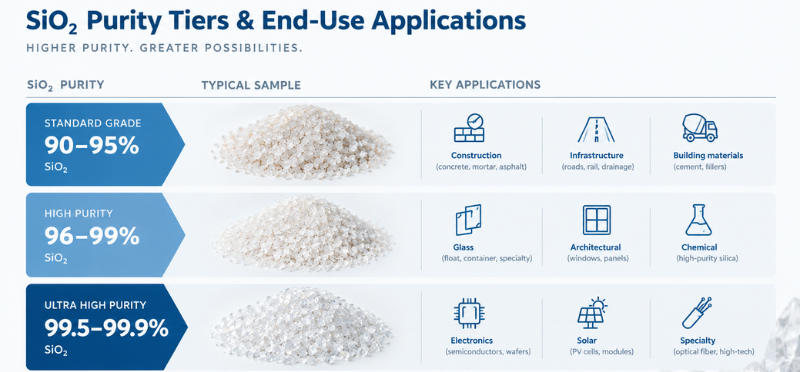
The "high purity" is not a single number, but a range, and that range is dependent on the object being created.
Quartz sand is not marketed by grade; it is graded by measurable SiO₂. The general rule of the game is:
|
Purity Grade |
SiO₂ Content |
Typical Applications |
|
Industrial / Construction Grade |
95% – 98.5% |
Foundry sand, construction aggregates, general fill |
|
Standard Glass Grade |
98.5% – 99.5% |
Container glass, general glass manufacturing |
|
High-Purity Glass Grade |
99.5% – 99.7%+ |
Flat glass, specialty glass, tableware |
|
Ultra-High-Purity Grade |
99.8% – 99.9%+ |
Electronics, solar (photovoltaic), semiconductor applications |
Here is one useful rule: 99.9%+ SiO₂ (with controlled trace elements) is needed for electronic and solar applications, whereas for glass-grade applications, 99.7%+ SiO₂ (with controlled trace elements) is needed. Products sold as "high-purity" silica, or SiO₂, should be examined carefully if they don't approach 99.5% SiO₂.
In our own network of 15+ verified silica producers, the average purity is 99.5%+ SiO₂, but the average is why it's not enough to look at the number on a general spec sheet. Inquire about the method used to test that percentage (typically, XRF) and also whether it is an average of the production run or a single sample. But one place where a lot of "high purity" claims go awry is batch consistency: Your supplier might be within 99.7% on your sample; but once the shipment arrives, it may be a different story.
Where the applications are at the "high end" of the purity range, it may be worth comparing the trace-element controls of sand specifically qualified for semiconductor/electronic manufacturing with those of general industrial sand, because the headline SiO₂ value might appear similar.
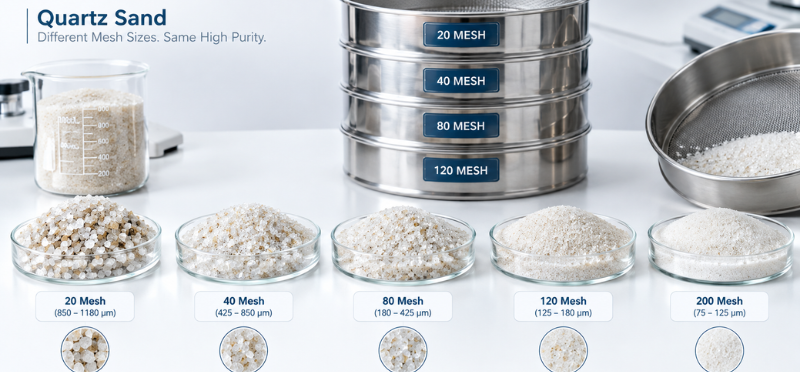
Purity gets the sand into consideration. The size of your mesh is crucial to its effectiveness in your process.
Mesh size is the particle size distribution, determined by the number of particles that pass through a screen with a specified number of openings per inch. The less spread out your distribution is around your target mesh, the more predictable your downstream results are, whether it's your melt behavior in a glass furnace, packing density in a foundry mould, or the flow rate in a filtration bed.
Common mesh ranges and typical places where they are specified:
|
Mesh Size Range |
Common Use Case |
|
20/40 |
Foundry sand, filtration media, proppant applications |
|
40/70 |
Glass manufacturing, general industrial filtration |
|
70/140 |
Fine glass applications, ceramics, specialty filtration |
|
140+ (fine powder) |
Electronics, high-precision ceramics, certain solar applications |
The spec sheet must contain the mesh range and the particle size distribution curve. The spec sheet must contain the actual width of the distribution, as well as the percentage of the mesh that drifts to oversize and undersize. A trusted high-purity quartz sand supplier may state that they provide mesh within a certain range, but 15% of the shipment may actually fall outside that stated range. The supplier provided what was stated, but that does not necessarily mean that the job would be processed within that specified range.
Drift in the mesh size of a particular shipment may occur, but consistent drift over a series of shipments indicates problems with the processing and/or sourcing of that product. It is important to understand how a supplier addresses these issues. Questions about screening frequency, calibration of screening equipment, and the sample retention policy for each shipment may provide insight into how a supplier addresses these issues.
The percentage of SiO₂ may be within specification limits, but trace elements may be within specification limits and still contaminate the final product.
The two trace elements that may affect glass and ceramics are:
Fe2O3 may cause discoloration and affect the clarity of glass. For some applications, Fe2O3 may need to be below 100 ppm. For solar and electronics applications, Fe2O3 may need to be below 20-30 ppm.
Al2O3 (Aluminum Oxide) affects the melting behavior of materials and influences electrical and thermal properties in various applications. Limits are defined more by the application and can be as low as a few ppm. More often than not, higher purity levels are favored.
Additional trace elements can be important, depending on your line of work. These elements include TiO2 and CaO, as well as alkali metal oxides such as Na2O and K2O. Trace levels of these elements can affect the performance of materials used in the production of specialty glass and other electronic and electrical devices.
In an industrial setting, great importance is placed on testing. Understanding how trace elements were measured is more important than the elements themselves. It is also important to understand whether trace element test results are from a single test or are averaged results. Results of trace element testing, performed by an independent laboratory, are more important when available for each individual shipment or lot than when reported for a given product line.
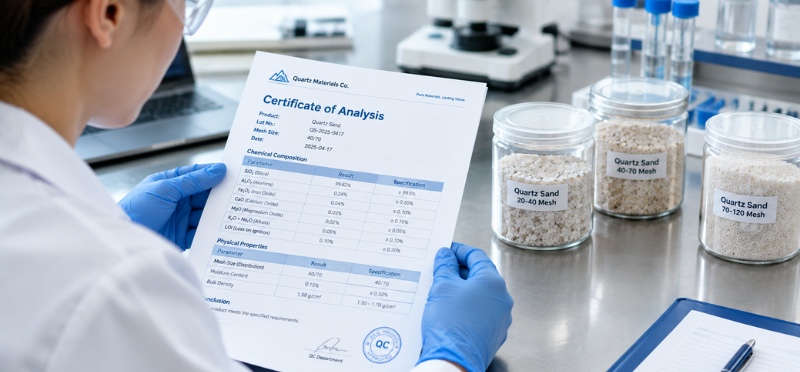
A Certificate of Analysis (COA) is typically the most crucial document provided by a Quartz Sand supplier. Creating a COA is very simple, but many suppliers intentionally do not provide this document to their customers.
A COA should at least provide:
If a supplier cannot provide a COA for the shipment you are interested in, ask for a product data sheet. A product data sheet describes the general characteristics of a product, while a COA describes the characteristics of the specific shipment.
We can provide a sample COA for Quartz Sand for your review. Our Quartz Sand shipments are accompanied by Certificates of Analysis and ISO Reports. If you are interested in Quartz Sand, we will be happy to facilitate your shipment.
We’ve compared enough spec sheets to spot trends when a producer is letting their marketers write their own “high-purity” copy.
Purity values may vary even among products used in the same application. Producers in these industries may use the information provided here to help them understand the reasoning for their skepticism before making large purchases.
Purity levels of high-purity quartz sand generally begin at 99.5% to 99.7% SiO₂. Purity levels of quartz sand used in the manufacture of semiconductors and solar cells should be 99.8% to 99.9% or greater. Sand of lower purity should be considered standard or industrial sand.
The mesh size of quartz sand depends on the sand's particle size and the application. In general, 20/40 mesh sizes are used in foundry and sand filtration applications. The size of quartz sand used in the manufacture of glass may be 40/70 mesh. The sizes of quartz sand used in the manufacture of advanced electronics and filtration may be 70/140 or higher.
An ideal supplier should provide batch certifications. The certifications should state the sand's purity level and other characteristics. The certifications should come from reputable organizations.
A supplier should provide a batch COA. The COA should state the purity level, the sand's characteristics, and the method of analysis. XRF is the most common analytical method. Impurities at the parts-per-billion level should be verified by an independent lab.
Industrial sand is generally 96% to 98.5% SiO₂. Quartz sands of lower purity may be considered standard sand. Sand of greater than 99.5% is considered high-purity sand. Quartz sand of less than 99.5% purity is not appropriate for sand used in the manufacture of glass, ceramics, or other applications where impurities affect the performance of the product.
Our competitors’ product sheets provide all sorts of numbers such as impurity levels and mesh distributions. Without documentation specific to the product being sold, those numbers hold little to no meaning. If a potential customer is considering purchasing from us in volume, we provide them with documentation similar to what we provide to Caloric Quartz: a certificate of analysis. That document discloses the testing method and the results.
There are a number of factors that influence a buyer’s decision to purchase in volume from one high-purity quartz sand supplier rather than from several other suppliers. For one, many buyers will prefer purchasing from a larger supplier that consistently documents its quality control at scale, rather than from smaller suppliers that aren’t able to consistently provide documentation for every batch.
If a buyer is currently reviewing specification sheets, we would be happy to provide a sample COA. Total Silica wants their customers to be able to verify the purity of our quartz rather than have to take our word for it.
More spec sheets state that it's high purity than actually prove it. You'll find ten different pu
READ FULLFor a single lot of 300mm silicon wafers, the accumulated processing cost can reach hundreds of t
READ FULLSilica sand is widely present in modern industries. It is used in glass, construction, oil and ga
READ FULL