



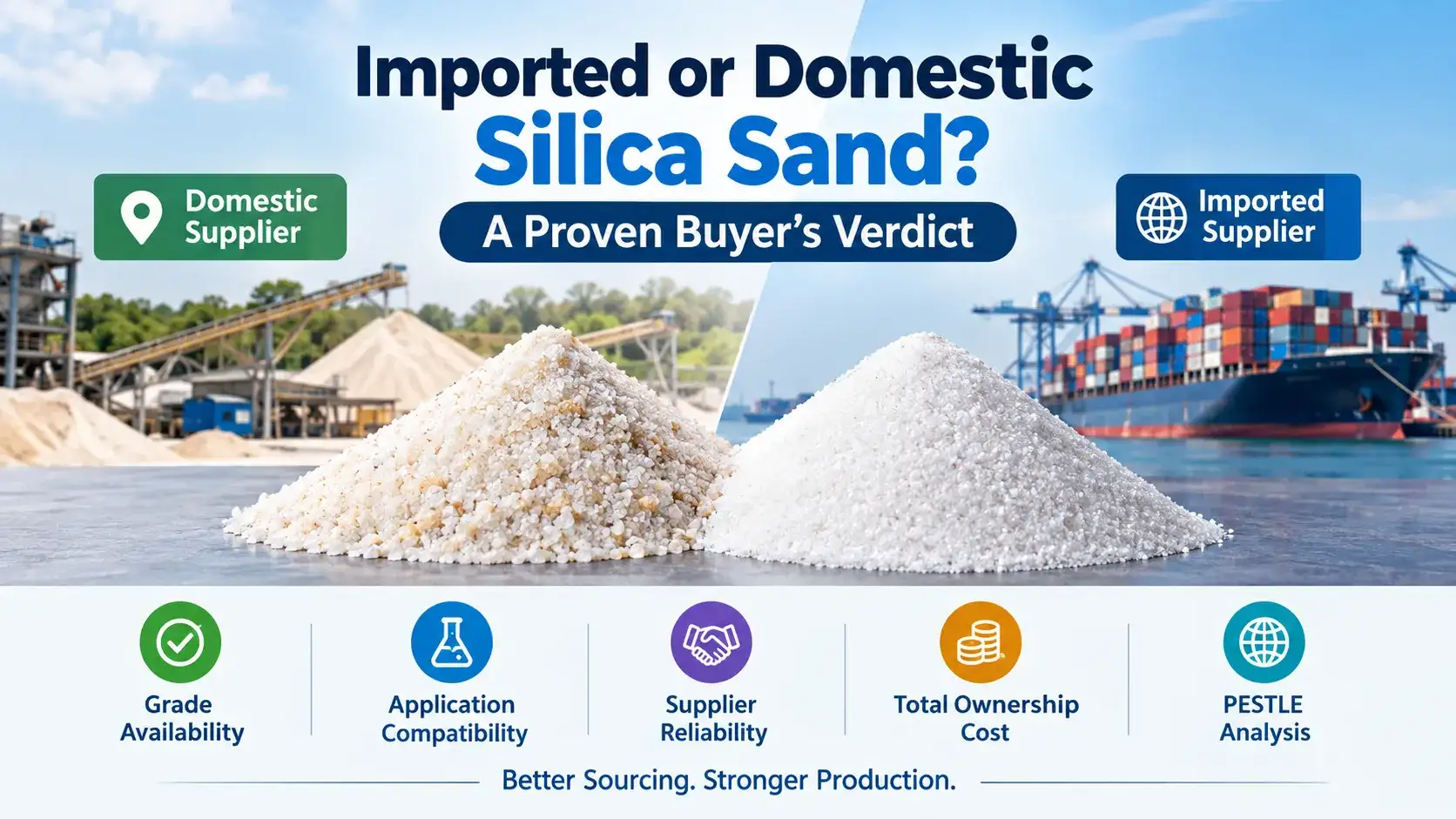
Industrial manufacturers require silica sand for various products. Semiconductors, glass, solar panels, ceramics, foundries, abrasives, and many products need silica sand. These are all completely different products from each other, but silica sand is a common ingredient among them. The difference comes through grade type, and sourcing becomes challenging when you do further analysis. There is another confusion among buyers when they have domestic and internal suppliers available, but the dilemma is high. To eliminate that dilemma, here is the comparison you need to read.
Before you decide whether you should go with imported or domestic silica sand, you need to analyze its availability. If it is available in your country, you will not have to go for the import option. Then comes the supply capacity of the supplier, which sometimes is not enough for some industrial buyers.
There are some countries that lead in the export sector of silica sand because of having abundant resources. The US, Saudi Arabia, Belgium, the Netherlands, Germany, Egypt, Malaysia, Indonesia, and France are prominent hubs of silica sand. If you are from any of these countries, you might not need to import silica sand. It is as simple as that. However, there are many factors, such as production size, grade compatibility, and price, that may compel you to import. Glass makers, for example, face tight specs, so see our guide to silica sand for float glass production.
The purity level, mesh size, or grade are the core requirements of every manufacturer when sourcing silica sand. Every application requires a specific grade because no other grade is compatible with that specific application. If you are not aware of silica sand grades for industrial applications, you can read our silica sand grade selection guide.
The composition of silicon dioxide, ferric oxide, and other compounds affects the selection process. You need to be precise when sourcing silica sand, because your domestic supplier might not have that specific composition. This is where you will have to go for an import option. The silica sand’s mesh size selection is one of the primary steps in selecting a supplier. You need to compare both options, domestic and international, for the best outcomes.
When selecting between both options, you need to do further supplier analysis. It might be a comparison of domestic suppliers, international suppliers, or even domestic and international suppliers. Ask for the silica sand composition, grade, mesh size, production capacity, and stock replenishment speed from each supplier. Also ask for certifications, business license, and export documents (exporter), along with supporting documents. These factors will help you find a supplier who can meet your exact requirements.
For example, read what to check in purity grades, mesh sizes and certifications buyers should verify when comparing suppliers. ISO-certified manufacturing is mandatory when selecting a supplier, along with zero-compromise quality control. It is essential when analyzing the worldwide export capability of any supplier, whether it is domestic or international. You need to make sure your selected supplier deals in large-scale production to dispatch bulk orders via OEM/ODM services.
The next factor that will help you decide if you need imported or domestic silica sand is the cost of the process. The cost of the overall process, or total cost of ownership, is a core factor when selecting a vendor or a sourcing partner. Silica sand procurement, supply chain management, and every step contribute to the total cost of the process. You need to know about it in the ingredient sourcing of any application of silica sand. To see how volume buying changes the math, read why buyers go wholesale on industrial silica. Here are the main factors that affect this total cost.
When choosing between domestic or imported silica sand, you need to ask about the price. The price will vary as you compare all the compatible suppliers with your budget. You want a cost-effective solution, and the unit price will only be a small factor of it. For example, you get a low unit price from an exporter, but the shipping costs are high. In another case, you might get a very low price from a domestic supplier, but the grade or quality is not compatible. Even in some rare cases, there might be some issues in the local transportation process, and you cannot afford delays or high transportation costs.
You will have to negotiate factory-direct pricing to get the maximum discount. It is only possible when you are sourcing wholesale silica sand in massive volumes. In this way, you can get bulk discounts more easily. Another factor is that you will have to ensure you have a scalable supply chain and flexible sizes of silica sand shipments. Logistics costs include shipping, customs clearance, trucking, and many other costs in the process, especially when importing. Also, there will be additional costs for storage and handling processes. You can learn more about it in this storage and handling guide for silica sand buyers.
The last factor you need to keep in mind is the PESTLE analysis. It affects the procurement process because any disturbance in a country or region could disrupt the entire supply chain process. It could also increase the price of silica sand in a specific region if there are conflicts in other hubs. For instance, if there is disruption in West Asia, the demand for European, Asia-Pacific, and American exporters of silica sand might increase. Then you might need to select suppliers only from those regions. These factors can affect your decision when selecting between imported and domestic silica sand.
Lastly, we can say that the procurement of silica sand completely depends on multiple factors that we shared above. It is about the availability of compatible grade, quantity, and supplier of silica sand. If it is available in the domestic sector, you will not have to import it at all. If the domestic supplier cannot meet your requirements, you will have to go for the import option. Perform an analysis of the supply chain, total cost, suppliers, and PESTLE factors to decide what is better for you. Every buyer has different requirements in the industry. If your local supplier can’t meet your grade or volume, browse our range for trusted industrial silica sand supply backed by ISO and COA documentation.
The US, Saudi Arabia, Belgium, the Netherlands, Germany, Egypt, Malaysia, Indonesia, and France are some of those countries. They have an abundant supply of silica sand for industrial applications. They might have some differences in terms of silica sand grades and prices, but they all contribute to this huge industry.
If your domestic supplier cannot meet all your requirements or has limited supply, find an alternative. That alternative will be an exporter who has a compatible grade, competitive price, and large enough quantity of silica sand. Total Silica LLC could be a good option, and you can contact it for details.
You need to find multiple suppliers from local directories and B2B platforms. Then you need to compare them in terms of silica sand grade, mesh size, price, certification, supply size, and quality assurance. You also need to ask about industrial experience, quality consistency, logistics costs, etc. Then you will be able to select a compatible supplier. Total Silica LLC is one of them, and you can compare it with your shortlisted suppliers for a better idea.
Industrial manufacturers require silica sand for various products. Semiconductors, glass, solar p
READ FULLAround ten mega industries heavily rely on silica sand for the production process. Some of them e
READ FULLModern microchips have to comply with strict quality standards for global compliance. Every funct
READ FULL