



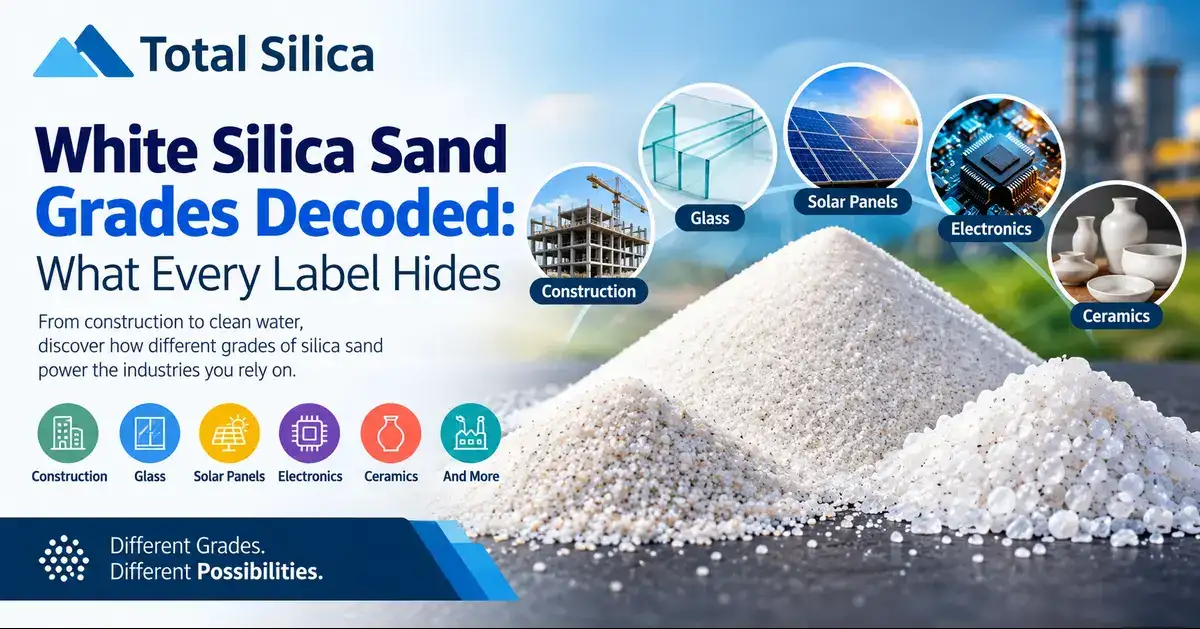
Around ten mega industries heavily rely on silica sand for the production process. Some of them even fully rely on white silica sand because it is the core ingredient for their production process. Those industries are electronics, glass, solar panels, ceramics, foundries, and the list goes on. The most sophisticated products and even the most abrasive products rely on the same ingredient. The difference comes in grade, which is about the purity and particle size of sand. For a deeper look at how these grades perform in real production, read our guide to high-purity silica sand applications in glass, foundry, and construction.
The first is construction-grade, whose purity level is below 95%. In other words, its mesh size is 50 to 70 mesh (0.297 mm to 0.210 mm). This grain size of silica sand is ideal for the production of concrete, mortar, brick, and asphalt in the construction industry. It strengthens them by adding high hardness, weight-bearing strength, and durability in construction works. If you are still deciding between grades, read this guide to selecting the best industrial silica sand before you shortlist suppliers.
The next is foundry-grade silica sand, whose purity is between 95% and 97%. Its grain size is 8 to 140 mesh (1.190 mm to 0.105 mm). This grade is compatible with foundry use because it provides superior resistance to extreme heat in the refractory and casting process. For the production of metal products, foundries need refractory bricks. Those refractory bricks need foundry-grade silica sand for production. This is how those bricks can withstand the heat of molten metal inside them. Also, silica sand is a core ingredient for the production of ceramics in investment casting.
Abrasive tools, machines, and chemicals need silica sand for their core function. In this grade, the purity of silica sand is between 95% and 97%. In terms of particle size, it is 20-40 mesh (0.841 mm and 0.400 mm). Applications like sandblasting also need the same grade of silica for extreme impact on metallic surfaces. Sandblasting operations can remove old coats of corrosion, patina, metal, and paint from metal surfaces. They need this specific grade to function with extreme strength. The same grade is used for the production of sandpapers, grinding wheels, and polishing compounds.
Ceramics need higher purity than the above types because they require smoothness. This is why its purity is higher than 98%, which means its particle size is 80 to 100 mesh (0.177 mm and 0.149 mm). This purity of silica sand is ideal for the production of ceramic molds, tiles, kitchenware, electrical components, medical and dental implants, and bathroom fixtures. Silica sand provides structural strength, dielectric properties, non-toxic nature, heat-sinking, and waterproofing to every component. If you make tiles or glazes, see our silica sand for tile and glaze manufacturing.
The oil and gas industry needs silica sand for the production of proppants in their underground operations. Those proppants need silica sand purity levels between 97% and 99.5%. In other words, they need sand particle sizes of 20-40 mesh (from 0.841 mm to 0.400 mm). These proppants can withstand extreme heat, abrasion, and pressure in that underground operation. Proppants are extremely tough and help keep the cracks open in the fracking process. The fracking process is a primary operation in oil extraction, and proppants are mandatory for it.
Also, this grade is suitable for silica fumes that add strength and reduce permeability in the soil. It works in all oil and gas underground extraction operations. This grade of silica sand is compatible enough to provide abrasion resistance, which maintains borehole pressure. Besides, this grade provides heavy-duty strength in oil well concreting.
Even water filtration processes for clean water and wastewater require silica sand. To provide compatible performance, treatment plants need water-filtration-grade silica sand. The purity is between 99.5% and 99.9%. This compact grain size of grains helps remove water impurities before the chemical treatment process starts.
Here is another unusual application of silica sand, which is in the production of plastic, paint, and rubber products. This industry uses plastic-and-paint-grade silica sand for multiple features in plastics, rubber, and paints. The purity level is 99%, which also means that the particle size is 80 to 100 mesh (0.177 mm and 0.149 mm). This grade of silica sand provides structural strength to plastic, rubber, and paint. Plastic gets its tensile strength, abrasion resistance, and hardness from the same grade. This silica sand also works as a reinforcement and aging resistance agent in plastic products. Transparent plastic gets its optical clarity from the same grade of silica sand. It works as a matting agent in paints and provides tear resistance to rubbers. To go deeper, see how industrial silica sand is used in filtration, coatings, and polymer applications.
Every glass needs silica sand for its production, and it requires glass-grade silica sand for that. That means it needs a high purity level, which is between 98% and 99.5%. In terms of particle size, it is 50 to 200 mesh (0.297– 0.100 mm). No matter what industry it is, every glass requires silica sand as a core ingredient. It could be household glass, automotive glass, building and construction glass, fiberglass, optical lenses, and even bulletproof glass. However, their strength, UV absorption level, transparency, and insulation may differ. This is why the purity level of this grade varies depending on the type of glass you manufacture. For float glass in particular, this float glass silica sand specification guide covers the details.
If we go for the production of fine glass, it is for solar panels and their protective glass. This is why this industry requires solar-panel-grade silica sand, whose purity is between 99.5% and 99.8%. The particle size is very fine, at 150 to 200 mesh (above 0.100 mm). The production of photovoltaic cells and their protective glass is different from standard glass. This is why the performance of solar panels may differ depending on the purity level of silica sand. Residential, commercial, industrial, military, and satellite applications need the same grade, but the purity of silica sand may slightly differ. Manufacturers can review our silica sand for solar panel manufacturing.
Now, this is where the highest purity of silica sand comes in. It is about selecting between 99.5 and 99.9% purity of silica sand for the production of the most sophisticated components. Semiconductors, PCBAs, and many other microcomponents need a particle size of 150 to 200 mesh (above 0.100 mm). The uniformity of particles has to be extremely high for the production of such sensitive semiconductors. Another sophisticated application of this grade is the production of optical fibers. One can hardly imagine the existence of internet service without them. Although there are a few satellite-based internet options available in this era, the last few decades have completely relied on fiber optic cables. Still, around 99% of internet users rely on systems that are based on fiber optics. Buyers in this segment can review our silica sand for semiconductor and electronics manufacturing.
White silica sand and silica sand are the same material. They are the core ingredient for the production of goods in half of the mega industries. Entire electronics, solar panel, glass, and ceramic industries rely on white silica sand. Besides, foundries, abrasives, and construction industries also heavily rely on silica sand for the production of their core products. However, they all need different grades of silica sand, which means the purity level and particle size of sand are different from each other. The finer the particle is, the more sophisticated the applications will be. Once you know which grade your process needs, ask a white silica sand supplier for COA documentation so you can confirm purity and mesh size before you order.
Both are comprised primarily of silicon dioxide (SiO₂) in the form of silica sand. The term "white" refers only to light color; this is generally associated with low iron and fewer impurities. The grade of a sand, its purity and particle size, and not color alone, will determine whether or not it is suitable for your process.
Thermite-grade is a very pure and fine quality of glass sand that is used by glass makers, as it contains less iron, which causes the glass to be a green color. It can be produced with a purity of up to 99.9% and a mesh size range from container glass to float glass, solar glass, and optical glass. Always check the specification against the glass that you make.
Begin with the application and then match the purity, particle size, and chemistry. Before ordering, check for iron and other trace impurities, review particle size distribution, and request a certificate of analysis (COA) from the supplier. The best last test is a small sample test on your own line.
With partnerships with 15+ verified silica sand suppliers, Total Silica LLC guarantees an average SiO₂ purity of 99.5%+. Each shipment is accompanied by ISO and COA certifications with third-party lab testing. Share your grade and mesh size, as well as the volume that you expect per month, and the team will confirm availability and give you a quote.
Industrial manufacturers require silica sand for various products. Semiconductors, glass, solar p
READ FULLAround ten mega industries heavily rely on silica sand for the production process. Some of them e
READ FULLModern microchips have to comply with strict quality standards for global compliance. Every funct
READ FULL