



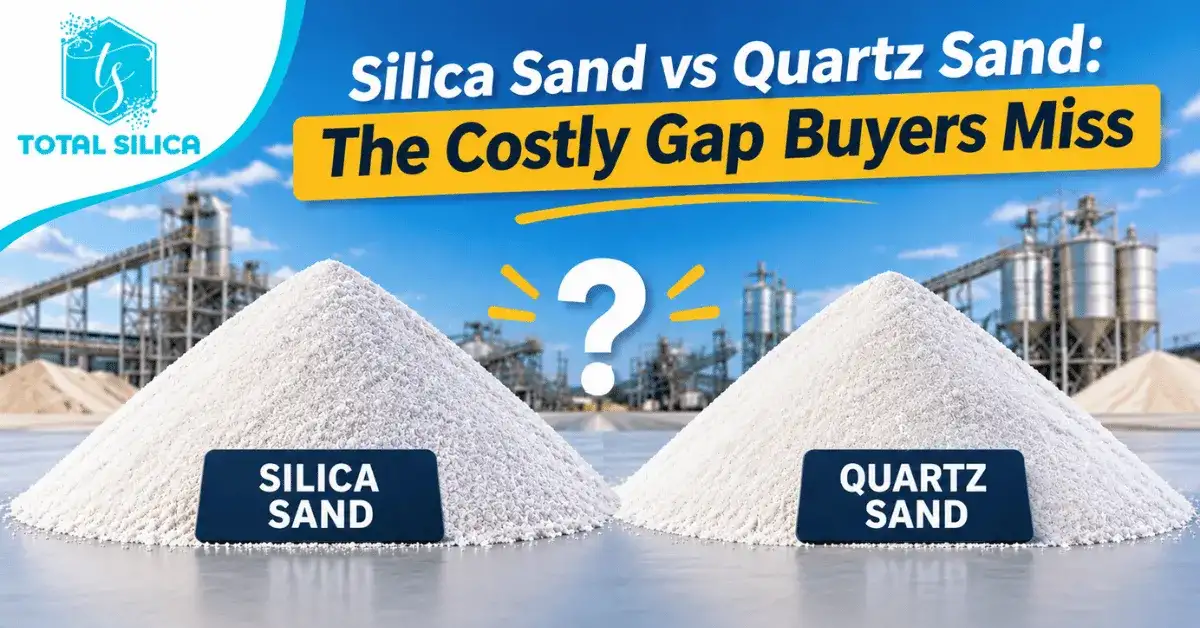
You have two quotes on your desk. One supplier is offering silica sand; the other is offering quartz sand. The second quote is higher, but the supplier describes it as a premium product.
Here you are faced with a challenging decision: Which one gives you better value?
The answer isn’t in the label. Silica sand and quartz sand can refer to the same industrial material, and neither label tells you whether a shipment will meet your requirements.
Then there is the sourcing budget. A shipment that looks cheaper on paper becomes costly once freight, moisture, processing, waste, and production disruption are added.
For industrial buyers like you, the best approach to bulk purchasing is to compare the specs of what you’re actually buying before you compare prices.
The difference between quartz sand and silica sand is often less clear-cut than buyers expect.
Silica is silicon dioxide, a chemical compound. Quartz is a common crystalline form of silica. Industrial sand with a high silica content can be sold in the market under multiple names like silica sand, quartz sand, or industrial sand. In practice, these names often overlap, but that does not mean every product is interchangeable. Two suppliers can use the same name for materials with different impurity levels, particle sizes, and moisture, and that is where the difference lies.
| Buyer’s question | Silica sand | Quartz sand |
|---|---|---|
| What does the name describe? | Industrial sand sold for its silica content | Sand described by its quartz content |
| Can the terms refer to the same material? | Yes. Silica sand often contains substantial quartz. | Yes. Quartz sand may also be sold as silica sand. |
| Does the name guarantee purity? | No. Request measured silica and impurity levels. | No. “Quartz” alone does not mean higher purity. |
| Does the name establish particle size or suitability? | No. Check the specifications against your application. | No. Check the specifications against your application. |
| What should buyers compare? | Chemistry, particle size, moisture, consistency, and delivered cost | The same properties, measured against the same requirements |
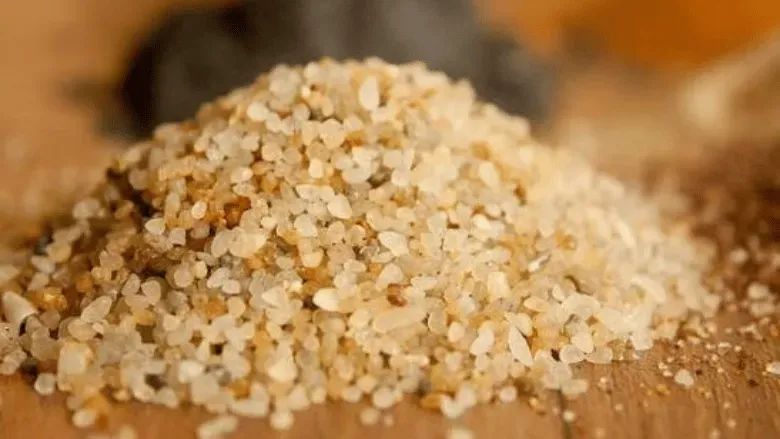
High-purity quartz is a specialized sand category used in industrial applications where trace impurities must be tightly controlled for factory processes. Here, the right label is not enough to guarantee purity. Industrial buyers need to know which impurities were measured. They need to know how they were tested, and whether the test results meet the limits for their industry-specific processes. For a closer look, read our guide to purity grades, mesh sizes and certifications buyers should verify.
When you’re deciding on the purchase of silica sand vs quartz sand, start with the properties your process needs.
Silicon dioxide (SiO₂) purity levels in sand are an important starting point, but they don’t tell the whole story. A product can have a high silica percentage and still contain an impurity that causes problems in your process. For example, iron oxide content in silica sand may matter to a glass producer because iron changes the color of the finished product. But the acceptable level of iron oxide depends on the glass type being made and the rest of the formulation. Glass makers can see how tight these limits get in our float glass silica sand specification guide.
Here you need to ask your technical team to define the relevant limits. After that, request measured test results from the supplier in clear units, along with the test methods used. One of the most common mistakes buyers make is relying on terms such as “premium” or “low iron” without an agreed numerical specification.
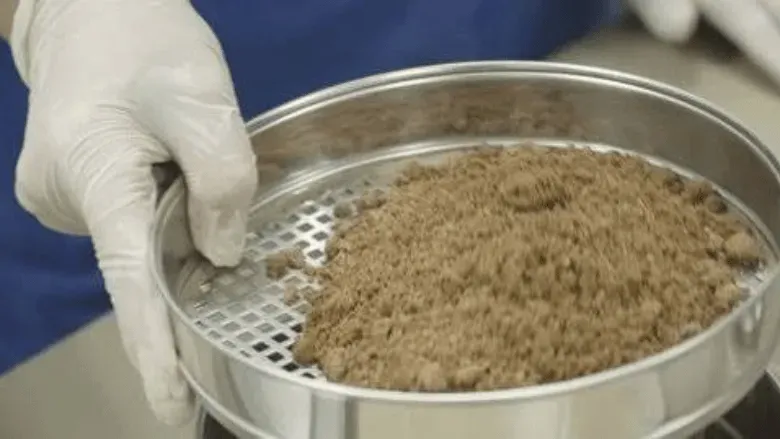
Chemical properties are only one part of the equation when deciding between quartz sand and silica sand. Particle size is also a crucial aspect.
While doing the particle size check, inspect the full particle size distribution rather than relying on a single advertised mesh size. Your process may be sensitive to fines, oversized grains, or variation between deliveries.
Moisture is another property that is equally important. You may pay to transport water, then spend more to dry the sand before use.
| Specification | Why it matters | What to request |
|---|---|---|
| Silica and impurities | Determines chemical suitability | Limits, measured results, and test methods |
| Particle size distribution | Affects processing and end use | Sieve results and limits for fines and oversize |
| Moisture | Affects handling, freight, and drying | Maximum moisture and pricing basis |
| Lot consistency | Supports predictable production | Results from representative production lots |
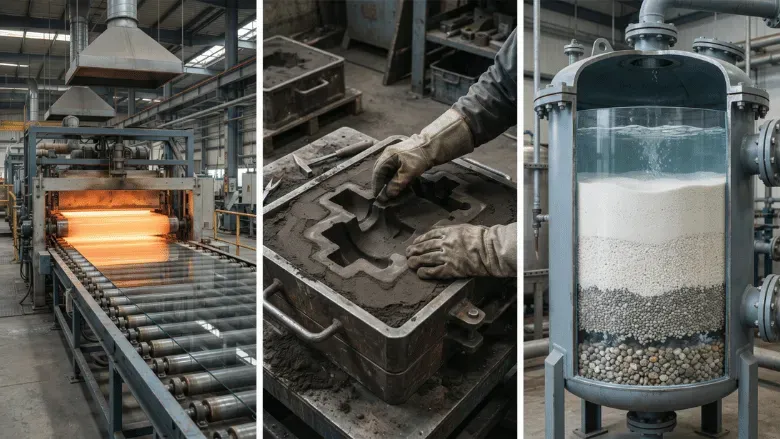
The right sand specification depends on what product you are manufacturing and the production process behind it. If you are producing glass, chemistry and impurities will take a higher priority. For a foundry, grain characteristics and consistency become more significant as they affect how the sand performs in the molding system. For filtration, particle sizing, cleanliness, and applicable product requirements need attention. Read more about high-purity silica sand in glass, foundry and construction applications.
A requirement stricter than your process needs raises cost without adding value. A requirement that is too lenient can create quality problems. To strike the correct balance, you need to bring the procurement and the technical team into the same discussion. You need a material that works in the plant yet does not seem too costly on the spreadsheet.
A useful quote comparison starts by holding these constant: delivery point, quantity, moisture basis, and specification. Otherwise, you may be comparing different products and different services.
Include the add-on costs that apply to your purchase:
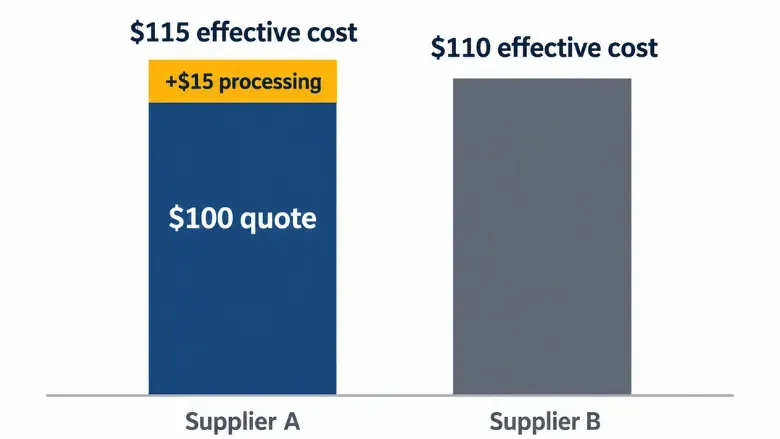
Consider this hypothetical example, not a market price:
Supplier A’s effective cost is therefore $115 per tonne, compared with Supplier B’s $110.
In this example, the cheaper quote costs you more because of additional processing. Small differences like these per tonne can become significant across a bulk contract. To see how volume buying affects this, read about the benefits of wholesale high-purity silica sand.
Before a bulk order, check the supplier’s documents and agree on how each shipment will be accepted.
Request a specification sheet with agreed limits and test methods. Also, ask for lot-specific certificates of analysis where available, along with origin and traceability information.
Review the spec results across recent production lots. If the sand supplier is claiming to supply consistent quality, the data should match the claim.
Also ask the supplier for applicable certifications and safety information. Different industrial processes require different specs, so confirm which documents matter to your operation.
Before placing a bulk order, agree on the following:
After agreeing to these terms, proceed to test a representative sample or run a controlled trial. It is vital that internal testing by your team be done to verify the supplier’s certificate.
Finally, check lead times and delivery arrangements. A suitable material is only useful if it reaches your site on time. Delivery and storage affect quality too, so see these storage and handling best practices.
Before you approve a supplier, confirm that you have:
If you are still shortlisting grades, read our guide to selecting the best industrial silica sand.
The best material isn't the one labeled "quartz," and it isn't always the lowest quote. It's the one that meets your process requirements, is backed by measured test results, and still wins when suppliers are compared on the same basis. Total Silica sources high-purity natural silica sand through 15+ verified producers, with a 99.5%+ average SiO₂ purity. Every shipment includes ISO and COA documentation backed by third-party lab testing. Share your specification, volume, and delivery point, and we'll confirm availability and a quote.
They can be. The terms often overlap, but products sold under either name can have different specifications. Testing the material and checking its certifications is the only way to confirm it suits your process.
No. This is a popular misconception. A supplier calling a product quartz sand does not, by itself, establish its purity. Buyers should request measured results and test methods.
Not necessarily. It depends on the grades, processing, specifications, volumes, and delivery terms being compared. The names alone don’t establish a price difference.
That’s a risky move. You should assess other characteristics like relevant impurities, particle size, moisture, consistency, and performance in your own process before approving a switch.
You have two quotes on your desk. One supplier is offering silica sand; the other is offering qua
READ FULLIndustrial manufacturers require silica sand for various products. Semiconductors, glass, solar p
READ FULLAround ten mega industries heavily rely on silica sand for the production process. Some of them e
READ FULL